A collaborative speaker series brought to you by:


Series
Living with Difference in an Age of Algorithms: Anekāntavāda, Ahiṃsā, and the Ethics of Limits
Mar 27, 2026
9:00 - 10:00 AM PDT
Watch the Replay

Presenter: Raja Rosenhagen, Assistant Professor, California State University, Fresno
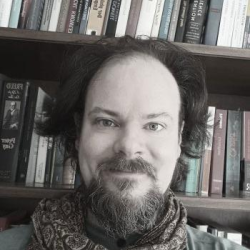
Raja Rosenhagen is Assistant Professor of Philosophy and Peace & Nonviolence Studies at California State University, Fresno. His work brings classical Jain philosophy—especially anekāntavāda (many-sidedness) and ahiṃsā (nonviolence) into conversation with contemporary questions about reasoning, conflict, and coexistence. Trained in both analytic philosophy and South Asian traditions, he approaches Jain thought not simply as a historical archive but as a living philosophical resource for everyday life and public discourse.
He has previously held research positions in India and was the inaugural Vasu Pujya Swami Postdoctoral Fellow in Pittsburgh, experiences that continue to inform his engagement with Jain philosophy from within the tradition. He is currently developing a book project under the title Thinking with the Jains, which brings Jain philosophical tools into dialogue with contemporary debates in ethics, pluralism, and public life.
“Living with Difference in an Age of Algorithms: Anekāntavāda, Ahiṃsā, and the Ethics of Limits”
How can we live with deep differences—religious, political, cultural, or personal—without either retreating into relativism or hardening into certainty? In an age shaped by algorithms, speed, and overconfidence, this question has become increasingly urgent. This talk explores anekāntavāda, the Jain philosophy of many sidedness, as a lived ethical practice rather than a purely theoretical doctrine. Rather than treating anekāntavāda as the claim that “everyone is right,” the talk presents it as a discipline of recognizing the limits of one’s own understanding—especially in thought, speech, and judgment. From this perspective, ahiṃsā (nonviolence) emerges not only as a principle of action, but as a practice of self-limitation that makes room for others without erasing difference. Drawing on everyday examples—from family disagreements and public discourse to social media and emerging technologies—the talk shows how Jain philosophical tools can help us navigate difference without domination. The aim is not to offer technical philosophy, but to demonstrate how anekāntavāda can be engaged as a practical resource for ethical life in a complex, pluralistic world.